About Binary Builder
A free binary to decimal practice game. Flip bits to convert decimal, binary and hex — then use the same skill to crack subnet puzzles.
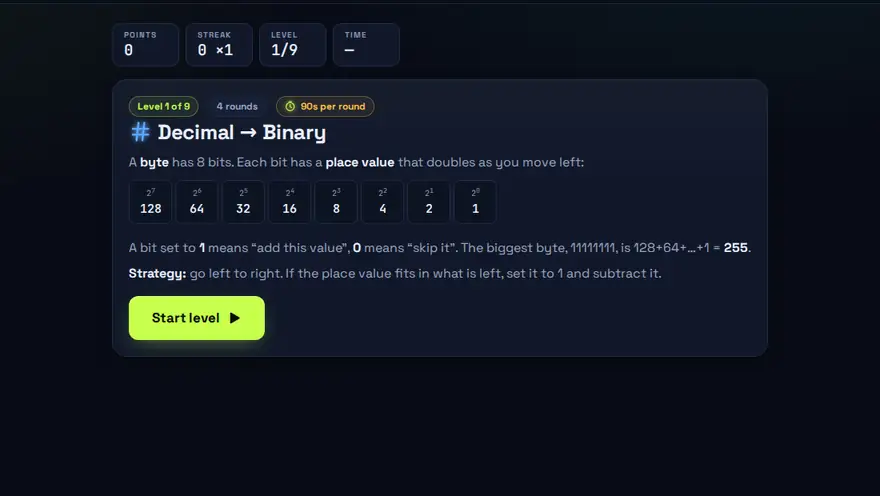
Skills you practise
- Binary
- Hexadecimal
- IP addressing
- Subnetting
How to play
- Toggle bits to match the target number.
- Move up from decimal → binary → hex.
- Final levels: subnet masks and network addresses.
Why this skill matters
Computers store everything as ones and zeros, and IT people meet binary and hexadecimal in IP addresses, colour codes, memory addresses and file permissions. Understanding the number systems makes subnetting and low-level troubleshooting far less mysterious. It works as binary conversion practice for a computer science class or an IT course, and as subnet mask practice for beginners, because a subnet mask is simply a run of binary ones followed by zeros. If that term is new, start with what a subnet mask is.
Key terms you will meet
- Bit and byte
- A bit is a single 0 or 1. A byte is eight bits and can hold 256 different values (0 to 255).
- Binary (base 2)
- A number system that uses only 0 and 1. Each place is worth double the one to its right: 128, 64, 32, 16, 8, 4, 2, 1.
- Hexadecimal (base 16)
- Uses 0-9 and A-F. One hex digit equals four bits, so FF is 255.
- Subnet mask
- A pattern of ones and zeros that splits an IP address into network and host parts.
- CIDR notation
- A short way to write a mask, such as /24, meaning the first 24 bits are the network part.
- Host
- A device on a network. A /24 network has 254 usable host addresses.
A worked example
Convert decimal 202 to binary. Start with 128: it fits, remainder 74. 64 fits, remainder 10. 32 and 16 do not fit. 8 fits, remainder 2. 4 does not fit. 2 fits, remainder 0. Reading the places gives 11001010. In hex that is CA, because 1100 is C and 1010 is A. The game then uses the same skill to work out how many hosts a /26 subnet allows.
Common mistakes to avoid
- Reading binary from the wrong end.
- Forgetting that hexadecimal letters A to F stand for 10 to 15.
- Counting the network and broadcast addresses as usable hosts.
Questions people ask
Why do computers use binary?
Electronic circuits are most reliable with two states, on and off, which map directly to 1 and 0.
Do I need binary to work in IT support?
Not every day, but it is essential for networking certifications and for understanding subnetting.
How do I convert binary to decimal?
Write the place values 128, 64, 32, 16, 8, 4, 2 and 1 above eight bits, then add the values that sit above a 1. For example, 00001101 has the 8, 4 and 1 switched on, so it equals 13. Binary Builder lets you practise this by flipping bits until the number matches.
Level: Beginner · Best for: Beginners · Part of the Networking path. Pass it to earn the “Binary Builder Master” badge and a game certificate.
Related: Network Setup Simulator, Packet Runner · Next: OS Installation Challenge · All 18 games · About · IT glossary
Quick answers: What is a subnet mask?
Content reviewed by Hritik · 2026-11-11.