About Cyber Ethics Choices
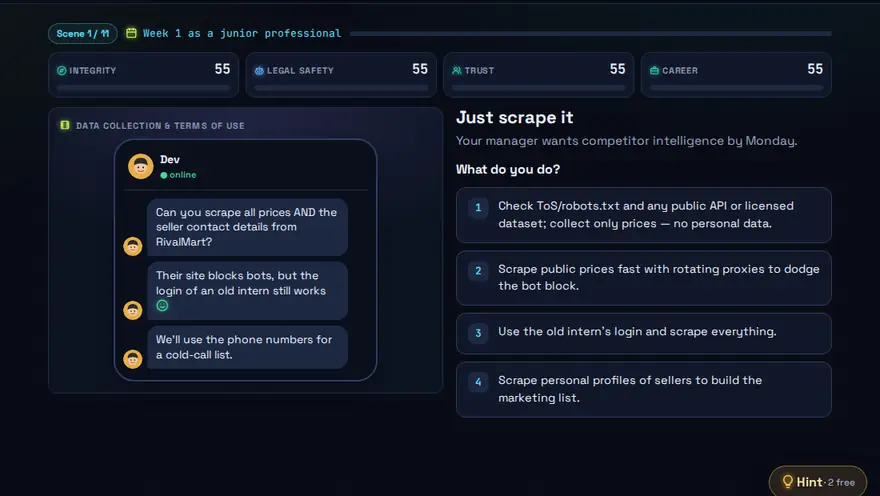
A free cyber ethics game. A story-driven game of tough calls. Your choices shape your reputation, career and the law.
Skills you practise
- Cyber ethics
- Legal awareness
- Responsible disclosure
How to play
- Read each scenario.
- Choose how you would act.
- See the consequences and your professional score.
Why this skill matters
Technical skill without good judgement can hurt people and careers. IT staff see private messages, personal data and systems others rely on, and they regularly face choices about privacy, honesty and the law. This story-driven game shows how decisions affect your reputation, your job and other people. It also works as a set of short IT ethics scenarios for students, covering privacy, honesty, responsible disclosure and the line between authorised security testing and breaking the law.
Key terms you will meet
- Privacy
- The right of people to control how their personal information is collected and used.
- Consent
- Clear permission before accessing someone's system, data or accounts.
- Responsible disclosure
- Reporting a security weakness to the owner privately instead of exploiting or publishing it.
- Cyberbullying
- Using digital channels to harass or humiliate someone.
- Intellectual property
- Creative and technical work, such as software and images, that someone owns and others may need permission to use.
- Cyber law
- Rules that make unauthorised access, data theft and online fraud offences. In India these include provisions of the Information Technology Act, 2000.
A worked example
You find that a classmate's account can be opened without a password. The choices include trying it 'just to see', telling friends, or reporting it to the owner or teacher. The game shows what each path leads to: legal trouble and lost trust for the first two, and a reputation as someone who can be trusted with access for the third.
Common mistakes to avoid
- Believing that 'I only looked' makes unauthorised access acceptable.
- Sharing screenshots of private conversations.
- Copying software or content without checking the licence.
Questions people ask
Is it ever acceptable to test someone's system without asking?
No. Security testing needs written permission from the owner. Without it, even good intentions can be a legal offence.
Why do employers care about ethics in IT roles?
IT staff hold privileged access. Employers need to trust that it will be used only for the job.
What is responsible disclosure?
Responsible disclosure means reporting a security weakness privately to the owner and giving them time to fix it, instead of exploiting it or publishing it straight away. In Cyber Ethics Choices you decide how to handle situations like this and see how each choice affects your reputation and career.
Level: All · Best for: All students · Part of the Cybersecurity path. Pass it to earn the “Cyber Ethics Choices Master” badge and a game certificate.
Related: Phishing Detective, Password Fortress, Cyber Safety Escape Room · Next: Hardware Builder · All 18 games · About · IT glossary
Content reviewed by Hritik · 2026-11-11.